
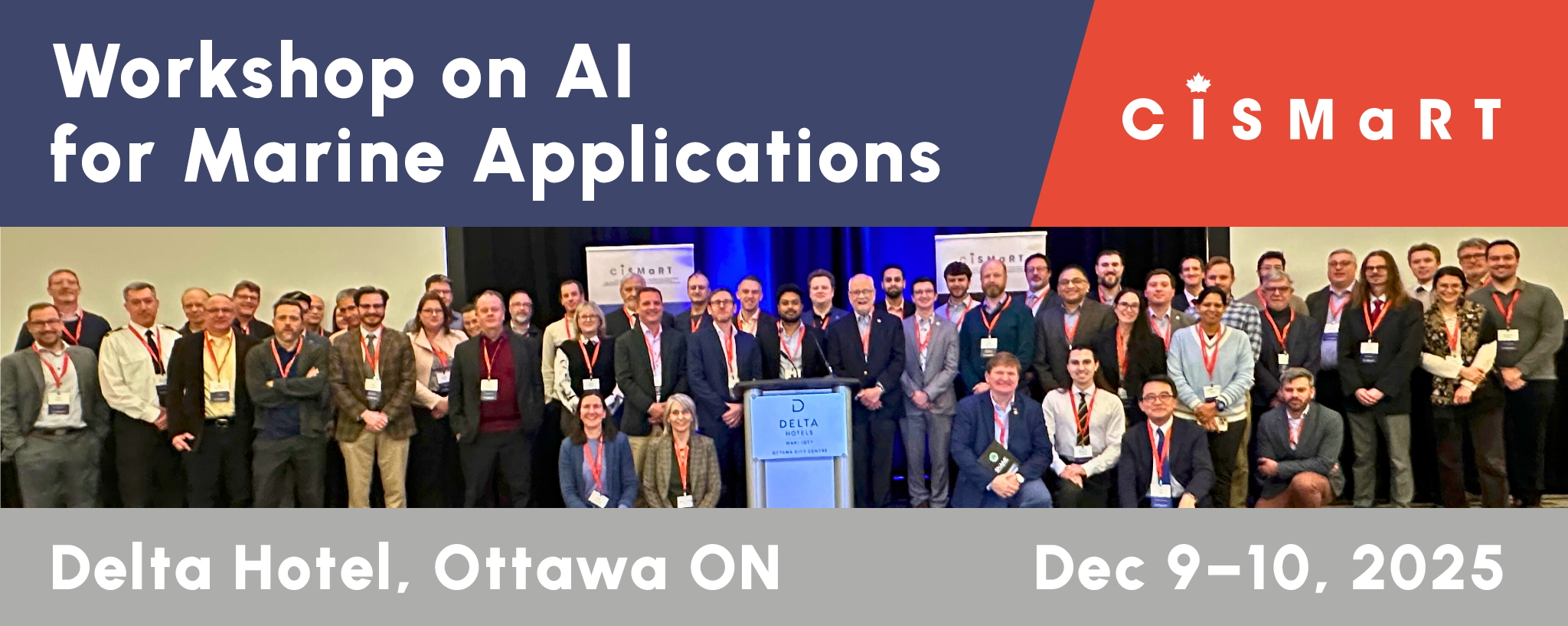
Workshop on AI for Marine Applications
Delta Hotel, Ottawa
December 9-10, 2025
Artificial intelligence (AI) and related technologies such as machine learning (ML) are rapidly transforming industries across the globe — and the marine and offshore sectors are no exception. To explore how these innovations can be effectively leveraged in Canada, a two-day workshop is being organized, structured around three key components:
Foundations of AI in Engineering
A half-day crash course designed to provide participants with a practical understanding of AI and related technologies. This session will clarify what AI can - and cannot - do, with a focus on engineering applications.Real-World Marine Applications
A series of presentations showcasing practical examples of AI in the marine industry. These will span a wide range of use cases related to the
design, maintenance, and operation of marine assets.Breakout Sessions
Collaborative discussions to identify potential projects for CISMaRT to pursue over the next three years.
-
December 9-10, 2025
Delta Hotel, Ottawa
Workshop Agenda -
See full list of bios here
-
Salih Abouassali, Senior Project Engineer, Department of National Defence
Olivier Allard, Digitalizatiion Director, Maya HTT
Karen Arsenault, Director Stategic Growth, InnovMarine Inc.
Eric Ashlee, Sub Comms Engineer, Department of National Defence
Roger Basu, President, Roger Basu & Associates Inc.
Tyler Beatty, Research and Development Advisor, ExxonMobil Canada
Anthony Beaupre-Jacques, Project Research Officer, Transport Canada
Adrian Black, Director of Product, MarineLabs Data Systems
James Bond, Director- Icebreaker Center for Excellence, Davie
Dale Braun, Principal Engineer, BMT
Jon Bruce, Senior Project Engineer, C-CORE
Luciano Carosielli, Rear Admiral (Retired), Royal Canadian Navy
William Champagne, Business Development Manager, BMTTracy Chatman, Policy Advisor, ISED
Matt Cleary, Vice President- Business Development, ABS Canada Inc.
Joel Corbin, Research Scientist, National Research Council Canada
Widens Desir, Digital Support Manager, Department of National Defence
Tony Diez, Naval Architect, Robert Allan Ltd.
Pierre-Charles Drapeau, President, InnovMarine Inc.
Adrian Egbers, Senior Advisor, Atlantic Canada Opportunities Agency
Dave Finn, CEO, Energy Research & Innovation Newfoundland and Labrador
Randy Giffen, Solution Architect, IBM Canada
Bodo Gospodnetic, President, Dominis Engineering Ltd.
Jacob Green, Life Cycle Material Manager, Submarine Air Systems, Department of National Defence
Jason Gu, Professor, Dalhousie University
Sandipan Halder, Data and AI Sales Specialist, InnovMarine Inc.
Randa Hamameh, Project Officer Innovation Centre, Transport Canada
M Sazied Hassan, CEO, CORSphere
Lee Hedd, VP Business Development, BMT
Nurul Ibrahim, CEO, atlantiq AI
Jasmin Jelovica, Associate Professor, University of British Columbia
Esa Karjalainen, CEO, Nikaxu Inc.
Max Kingsley, Project Officer, Department of National Defence
Ryan Klomp, Director RD&D, Transport CanadaVladan Kozarski, Naval Architect Engineer, Canadian Coast Guard
Yibo Li, Senior Software Developer, Lloyd's Register Advisory
Rosie Lickorish, Software Engineer & Senior Inventor, IBM
Heather Lindale, Numeracy and Business Curriculum Consultant (Intermediate/Senior Student Success Department), Ottawa Catholic School Board
Tom MacAdam, Team Leader, Lloyd's Register Advisory
Christian Mackereth, Policy Advisor, Natural Resources Canada (NRCan)
Olivier Maillet Glas, Project Officer, Engineering Transport Canada
Jennifer Major, Senior Project Manager, Memorial University- HHRDI
Nicolas Marcouiller, Innovation Manager, Department of National Defence
Maxime Maugeais, Commanding Officer Naval Training Group Headquarters, Royal Canadian Navy
Scott McConnery, Supportability Engineer, Department of National Defence
Paul Mitten, Vice-President, Compusult Limited
David Molyneux, Director, Ocean Engineering Research Centre, Memorial University
Marcel Montrose, President, Lir Maritime ConsultingDavid Murrin, Director General, National Research Council Canada
Jussi Niemi, President, Nikaxu Inc.
Chris Nowak, Sr. Engineer / Project Officer, Transport Canada - Innovation Centre
Chad Oldfield, Principal Naval Architect, Vard Marine Inc.
Shane Peddle, R&D Project Manager, Energy Research & Innovation Newfoundland and LabradorShelly Petten, Executive Director, Oceans Advance Inc.
Howard Posluns, Engineer, Transport Canada
Paul Preston, Executive Advisor, Energy Research & Innovation Newfoundland and Labrador
Wei Qiu, Department Head/Chair, Memorial University/CISMaRT
Jake Rigby, Head of Innovation and Reseach , BMT (UK)Marie-Chantal Ross, Program Director, National Research Council of Canada
Vlad S, VP AI, Nikaxu Inc.
Michelle Sanders, Director General, Innovation Centre, Transport Canada
Kyle Sexton, Data Analyst, DND
Amir Shayeghi, IT Analyst, Department of National Defence
Balsher Singh, Software Developer, National Research Council Canada
Jonathan Stokes, Research Development Officer, Transport CanadaRoopam Walia Sure, Senior Account Technical Lead, IBM
Alex Tennant, AI Scientist, Nikaxu Inc.
Matthyw Thomas, Senior Program Manager / Principal Engineer, ABS Canada Inc.
Ian Thompson, Defence Scientist Defence Research and Development Canada
Soufiane Toumi, Technical Support Specialist, Department of National Defence
Eric VanDerHorn, Manager, Technology for the Digital Research Team, ABSManoj Varghese, Digital Projects Engineer, Department of National Defence
Joshua White, Software Administrator – AVEVA AIM, AMS
Sergiy Yakovenko, Director, Albion Marine Solutions Ltd
Igor Zakharov, Senior Research Scientist, C-CORE
-
Group 1
Tyler Beatty, ExxonMobil, Group Lead
Chris Nowak, Transport Canada, Note Taker (break out)
Salih Abouassali, Department of National Defence
Eric Ashlee, Department of National Defence
Dale Braun, BMT
Joel Corbin, National Research Council Canada
Pierre-Charles Drapeau, InnovMarine Inc.
Randy Giffen, IBM Canada
Jason Gu, Dalhousie University
Esa Karjalainen, Nikaxu Inc.
Yibo Li, Lloyd's Register Advisory
Heather Lindale, Ottawa Catholic School Board
Michelle Sanders, Innovation Centre, Transport Canada
Igor Zakharov, C-CORE
Group 2James Bond, Davie, Group Lead
Chad Oldfield, Vard Marine Inc., Note Taker (break out)
Widens Desir, Department of National Defence
Tony Diez, Robert Allan Ltd.
Jacob Green, Department of National Defence
Sandipan Halder, InnovMarine Inc.
Randa Hamameh, Innovation Centre, Transport Canada
Tom MacAdam, Lloyd's Register Advisory
Jennifer Major, Memorial University Note Taker (general)
Paul Mitten, Compusult Limited
David Murrin, National Research Council Canada
Jussi Niemi, Nikaxu Inc.
Jonathan Stokes, Transport Canada
Matthyw Thomas, ABS Canada Inc.
Roopam Walia Sure, IBMGroup 3
Ryan Klomp, Transport Canada, Group Lead
Maxime Maugeais, Royal Canadian Navy, Note Taker (break out)
Karen Arsenault, InnovMarine Inc.
Adrian Black, MarineLabs Data Systems
Matt Cleary, ABS Canada Inc.
Adrian Egbers, Atlantic Canada Opportunities Agency
M Sazied Hassan, CORSphere
Max Kingsley, Department of National Defence
Rosie Lickorish, IBM
Nicolas Marcouiller, Department of National Defence
Howard Posluns, Transport Canada
Vlad S, Nikaxu Inc.
Balsher Singh, National Research Council Canada
Ian Thompson, Defence Research and Development Canada
Sergiy Yakovenko, Albion Marine Solutions LtdGroup 4
Dave Finn, Energy Research & Innovation Newfoundland and Labrador, Group Lead
David Molyneux, Memorial University, Note Taker (break out)
Olivier Allard, Maya HTT
Luciano Carosielli, Royal Canadian Navy
William Champagne, BMT
Tracy Chatman, ISED
Bodo Gospodnetic, Dominis Engineering Ltd.
Lee Hedd, BMT Canada
Vladan Kozarski, Canadian Coast Guard
Olivier Maillet, Glas Transport Canada
Scott McConnery, Department of National Defence
Kyle Sexton, Department of National Defence
Alex Tennant, Nikaxu Inc.
Manoj Varghese, Department of National Defence
Joshua White, AMSGroup 5
Marie-Chantal Ross, National Research Council Canada, Group Lead
Shane Peddle, ERINL, Note Taker (break out)
Anthony Beaupre-Jacques, Transport Canada
Jon Bruce, C-CORE
Nurul Ibrahim, atlantiq AI
Jasmin Jelovica, University of British Columbia
Christian Mackereth, Natural Resources Canada (NRCan)
Marcel Montrose, Lir Maritime Consulting
Shelly Petten, Oceans Advance Inc
Paul Preston, Energy Research & Innovation Newfoundland and Labrador
Jake Rigby, BMT
Amir Shayeghi, Department of National Defence
Soufiane Toumi, Department of National Defence
Eric VanDerHorn, ABS -
Background
In addition to the introductory course on AI and related technologies, we have had several presentations. The latter include the application of AI to various facets of the marine ecosystem ranging from metocean forecasting through maintenance to operations. These presentations indicate the power of AI technology. They also indicate the challenges associated with implementing AI-based solutions.
The use of AI and related technologies is likely to grow in the coming years. While some of the presentations did indicate the kind of applications that AI can usefully be applied to, there may be many others that are worth exploring. It is an objective of this workshop to help identify those procedures and activities in the marine ecosystem that lend themselves to the application of AI and related technologies, particularly in the context of Canada, and also to identify which ones show the most promise.
Objectives of Breakout Session
The overall objectives of the breakout session are to:
Summarize participants’ general views of AI and related technologies particularly applied to Canada’s marine industries.
Consider the application of AI and related technologies in the following areas related to ships and offshore structures:
• Design
• Operations
• Performance
• MaintenanceFor each of the above areas several topics will be considered as listed below under Topics for Discussion.
Identify potential research projects in AI and related technologies as applied to marine subject.
Breakout Session Approach
The workshop participants will be divided into five (5) groups, each group with approximately the same number of members. Each group will be asked to follow the procedure outlined here.A lead for each group has been preassigned.
A member of the group has also been preassigned as a notetaker to support the group lead.
The group lead will summarize the key points, observations and project recommendations.
After the breakout session is concluded the breakout groups will reassemble.
The results of the breakout session will be summarized by the group leads to the general session.
The written form of the breakout session will be submitted to the workshop facilitator by the end of the workshop.
NOTE: Workshop participants are encouraged to submit any additional information they have after the workshop. Additional submissions should be sent to: qiuw@mun.ca and roger.i.basu@gmail.com.
Examples of Topics for DiscussionRegulatory and legal uncertainty
Autonomous ships
Navigation
Remote control of ships
Maritime safety
Cybersecurity
Port operationsBerth allocation
Logistic support
Weather prediction
Characterization of climate for real-time application and also for design purposes
Operational route optimization
Trim adjustment
DesignShip hydrodynamics
Structural analysis and design
Underwater noise
Maintenance and InspectionMachinery
Structural health monitoring
Fatigue cracks & fractures
Remote inspection of ships and offshore assets
-
December 9th
CISMaRT Updates
—
Short Course: Overview of AI and related Technologies
Randy Giffen, IBM Canada
9:00-12:30
This short course provides a high-level overview of artificial intelligence (AI) and machine learning (ML) fundamentals, with a focus on how they can be applied in the engineering/marine industry. It will clarify key concepts, introduce common algorithms, emphasize the importance of data, and discuss examples of AI in engineering and maritime contexts. The goal is to give participants enough understanding to identify AI opportunities in marine engineering and operations, without delving into excessive theory.—
Metocean Forecasts Powered by Hyper-local Data Reduce Costs and Improve Safety in Maritime Operations
Adrian Black, MarineLabs
13:30-14:00
Adrian will present on MarineLabs' Forecast AI. Trained on a combination of local observations from MarineLabs sensor nodes and Numeric Weather Prediction models, MarineLabs produces bias corrected, hyper-local forecasts, specific to each of its sensor nodes. Grounded in local measurements, the complexities of coastal waters are implicitly accounted for, reducing forecast to observation error by up to 75% vs. NWP's like ECMWF and GFS. Adrian will discuss the models, how they have been operationalized, benefits to users and what's next.
—
The ICESIGHTS Project
Matthyw Thomas, ABS Canada
14:00-14:30
Adrian will present on MarineLabs' Forecast AI. Trained on a combination of local observations from MarineLabs sensor nodes and Numeric Weather Prediction models, MarineLabs produces bias corrected, hyper-local forecasts, specific to each of its sensor nodes. Grounded in local measurements, the complexities of coastal waters are implicitly accounted for, reducing forecast to observation error by up to 75% vs. NWP's like ECMWF and GFS. Adrian will discuss the models, how they have been operationalized, benefits to users and what's next.
—
From Mayflower to Machine Learning: Advancing Ocean Research with AI
Description
Rosie Lickorish, IBM
14:30-15:00
In this talk, Rosie will explore the art of the possible for AI at sea, starting with the story of the Mayflower Autonomus Ship's successful crossing of the Atlantic ocean, followed by an overview of the latest research into geospatial foundation models and how these can be applied to the marine sector.—
Establishing Digital Twin Credibility: Best Practices for Verification and Validation
Eric VanDerHorn, ABS
15:30-16:00
This talk will describe a structured framework to ensure trust in digital twin systems, including those incorporating AI and machine learning (ML). The presented framework provides rigorous methods to verify that digital twins leveraging AI/ML are built correctly and validated to ensure their outputs accurately represent real-world systems. By integrating criticality assessments and examining factors like data pedigree, uncertainty characterization, and input reliability, the framework ensures AI/ML models within digital twins are fit for their intended purpose. This approach is designed to validate not only digital twins but also the AI/ML methods underpinning their predictive and analytical capabilities, fostering confidence in these advanced technologies.—
From Compliance to Confidence: Building AI Ready Data Sovereignty Frameworks
Karen Arsenault, InnovMarine Inc.
16:00-16:30
As Canada accelerates digital transformation across the marine sector, the question of how that data is managed (governed) and where it is allowed to reside or move (sovereignty) has never been more urgent. This session explores how AI-enabled data governance can strengthen sovereignty, trust, and innovation simultaneously. Drawing from marine case studies, we’ll show how intelligent frameworks automate lineage, enforce policy, and transform compliance into confidence. Attendees will gain a practical view of how to operationalize sovereignty and embedding governance into the data lifecycle to ensure resilience, transparency, and readiness for AI. The result: data as a sovereign, trusted asset powering Canada’s digital future.
December 10th—
AI in Ship Design
Jake Rigby, BMT
08:45-09:15
Artificial Intelligence (AI), particularly through Machine Learning (ML), is transforming ship design providing a flexible new toolset that can allow us to think differently and explore more design solutions than ever before. AI and ML tools are not intended to replace the expertise of naval architects. Instead, they should be seen as collaborative aids to amplify the capabilities of human designers. This talk will explore various AI-driven approaches are being applied across different aspects of the ship design process but specifically in Hullform assessment and early-stage Structural design. The session will walk through the design process of one of BMTs new vessels, outlining the realistic efficiency saving.—
Machine Learning for Structural Analysis of Ship Hull Girders
Jasmin Jelovica, University of British Columbia
09:15-09:45
This talk presents a computational framework for global–local structural analysis of ship hull girders that integrates an equivalent single-layer (ESL) model with graph neural networks (GNNs). A coarse-mesh homogenized model efficiently predicts the global displacement field, providing boundary behavior for local panel FEA. Local data are used to train a heterogeneous graph transformer (HGT) that predicts detailed stress and displacement fields. The framework relies solely on the global ESL solution, enabling rapid, high-fidelity analysis across the hull girder. In collaboration with Seaspan Vancouver Shipyards, future work will explore generative AI and diffusion models for the rapid creation of optimal structural layouts, thereby assisting designers in the early stages of structural development.—
Machine Learning–Driven Analysis of Performance Data from CCG Vessels
Balsher Singh, National Research Council
09:45-10:15
This presentation explores the integration of machine learning components into the NRC Operational Visualization & Analytics (NOVA) platform, developed to enhance performance monitoring of Canadian Coast Guard vessels. It covers the extensive data availability from multiple ships, including fuel consumption, power usage, wind conditions, emissions, and ice camera imagery, emphasizing multi-source data integration. Key highlights include the visualization of performance curves correlated with ice conditions. Additionally, the presentation delves into the ML model explainer tool incorporated within NOVA, providing interpretable insights into model predictions. The talk aims to provide a comprehensive overview of how advanced analytics and data fusion support safer and more efficient maritime operations.—
Top Five AI Applications in Vessel Maintenance
Olivier Allard, Maya HTT
10:45-11:15
This session will help participants identify relevant use cases and validate the operational value of AI-driven solutions in the Marine sector. Examples in the following subject areas will be discussed: fleet management optimization, predictive maintenance, and environmental monitoring. These examples will be used to discuss the tools and technologies required to turn data into impactful solutions. The presentation will showcase Maya HTT’s experience with integration of physic based simulated data, Artificial Intelligence, IIoT collected data, and Enterprise Big Data to advance digital transformation in the marine industry. Focusing on engineering and operational reliability, the presentation will detail the strategy behind the deployment of IIoT infrastructure with edge/cloud data pipelines, and machine learning models for real-time anomaly detection and predictive maintenance. Technical case studies, including commercial program, illustrate the transition from manual processes to automated, data-driven fleet management. The main point will be to discuss challenges in integrating diverse data sources, contextualizing time-series data, and implementing secure, scalable solutions. The session highlights agile AI adoption, digital twins, and outlier detection for improved marine operations.—
Detecting Anomalies across Machinery and Sensor data with Predictive and Agentic AI.
M Sazied Hassan, CORSphere
11:35-12:00
In high-stakes industries, operational teams are drowning in data yet starving for insight. This overload masks "silent failures"—subtle anomalies that precede catastrophic breakdowns. CORSphere is solving this by building CORS-i, the "AI Doctor" for high-value machinery and autonomous systems. Our technology moves beyond simple alerts to provide true predictive intelligence. We transform unstructured sensor and operational data into actionable certainty, detecting and ranking anomalies with over 95% accuracy and contextually pinpointing the root cause. This cuts diagnostic guesswork, reduces data prep time by over 70%, and empowers crews with actionable, AI with human-in-the-loop plans. Our solution is being deployed across the defence, marine, and energy sectors, delivering operational readiness today while building the essential predictive foundation for tomorrow's fully autonomous systems.